In the Trenches of Change
About the Book
A Field Memoir of Reform, Culture, and Consequences
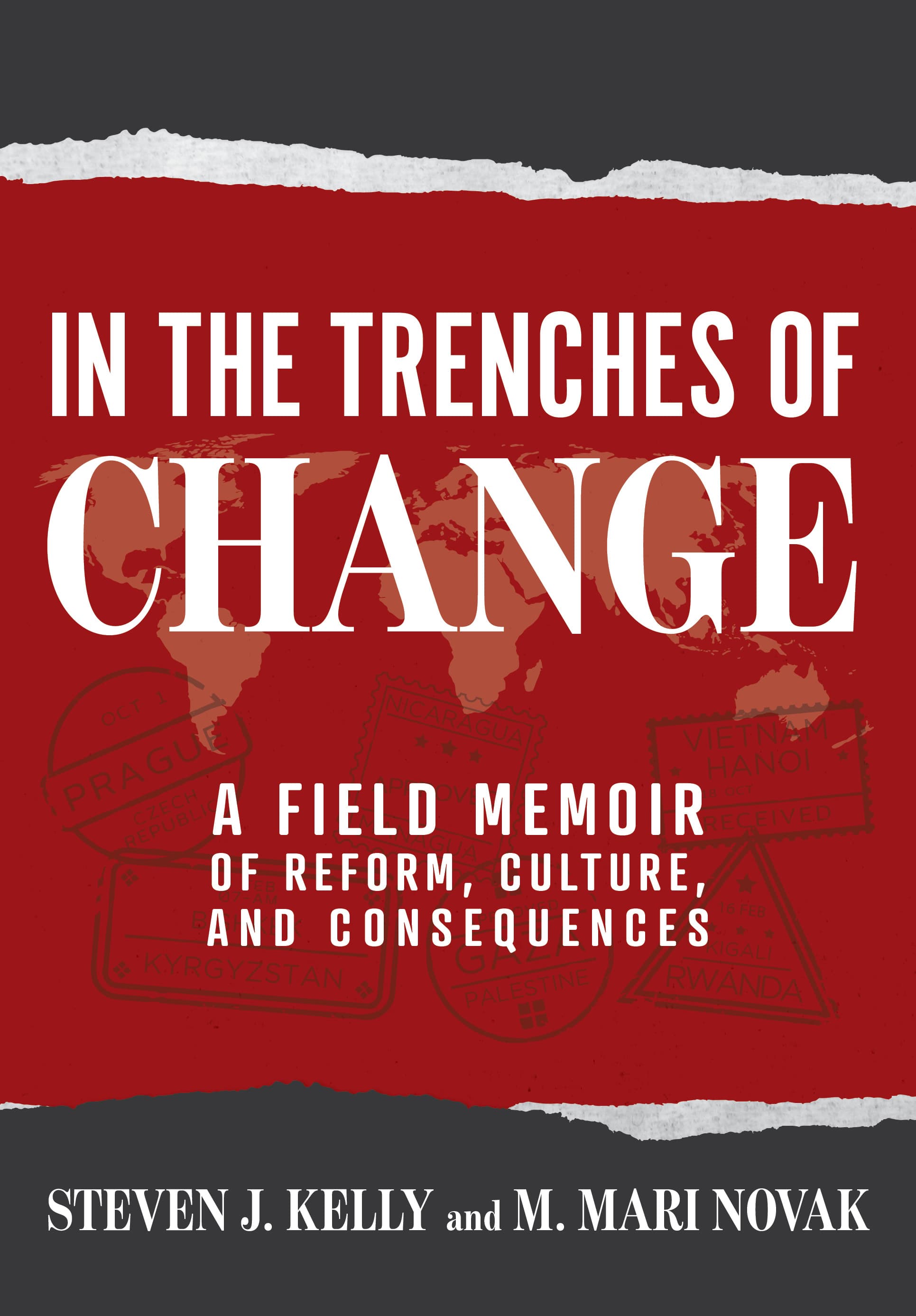
In the Trenches of Change is not a professional manual or a memoir, but a combination of the two. It goes inside institutions under pressure—ministries, public agencies, nonprofits, and businesses trying to improve performance while navigating politics, culture, bureaucracy, and conflicting incentives.
Told with candor, wit, and hard-earned humility, this book shows what manuals and case studies leave out: why best practices fail, how culture and incentives shape possibility, how unintended consequences disrupt systems, and what actually helps when the rules keep shifting.
4
Decades
5
Continents
25
Countries
The Five Parts
The book moves from personal origins through field practice, resistance, and endurance, to the lessons that lasted.
Part I
Origins
The beginnings: what shaped the authors, how they came to this work, and why they chose life beyond borders.
Chapters
- The Spark That Set the Fire
- In the Beginning
- Building a Business
- The Way We Look at the World
Part II
Seeing the Field Clearly
Culture, transition, dual priorities, and the difference between formal plans and how institutions really function.
Chapters
- The Cultural Factor
- When the Dust Settles
- Two Masters: Dual Priorities
- Doing Things Right Vs. Doing the Right Thing
Part III
Working the Field
Cases, methods, training, systems thinking, and the practical judgments forged in real assignments.
Chapters
- Experience is the Edge
- When Training is the Answer
- Triskele: Weaving Successful Outcomes
- Sometimes the Solution is Simple
- Complicated Versus Complex
Part IV
When Reality Comes Knocking
Resistance, fatigue, sustainability, and the stubborn difficulty of making change stick.
Chapters
- Staying the Course
- Planting Seeds in Stone
Part V
Beyond the Frameworks
The deeper lessons: what endured, what changed, and what still matters for those who do this work.
Chapters
- Lessons from the Edge
- Appendix I: Ten Key Insights
Sample Chapter · Part I
The Spark That Set the Fire
“Culture hides much more than it reveals, and strangely enough what it hides, it hides most effectively from its own participants.”
Mari: Someone asked me once what one thing started us thinking about doing the kind of work we do. And I had to pause a moment. And you know, it occurred to me it was something that happened oddly enough on our honeymoon.
Steven: Well, our honeymoon was kind of a precursor to everything we did after.
Mari: Steven and I got married in Houston in 1984. For our honeymoon, we decided to join a small “citizen-diplomacy” group on a five-city trip behind the Iron Curtain—to Baku, Moscow, Kiev, Yerevan, and Tbilisi. Because, of course, where else would you go during the Cold War? We had geopolitical interests, with much curiosity about what it was like to live in countries outside of our own. We wanted to meet local Soviet citizens and learn firsthand what life was like for them. To do that, we were told that bringing items to give as gifts or to barter might get us close to ordinary folks. And that denim clothing especially was in high demand. So, we packed an old Army duffle—that we borrowed from a Marine officer friend—with T-shirts, jeans, and even a rather fetching denim three-piece suit from the back of Steven’s 1970’s wardrobe.
At the end of December, we landed in Moscow in the harshest winter they’d experienced in fifty years. Like all visitors back then, foreigners were carefully monitored. We had to stay at specific hotels, and Olga, our “minder” (a minor security service operative), was with us wherever we went. With her always lurking nearby, it seemed we’d have no opportunity to tempt the Russians with our denim treasure trove. Or have unmonitored conversations.
But then one day, we were allowed to meander in an open-air market in Moscow. There wasn’t much for foreigners to buy, only rabbit and fox fur hats that would have been expensive back home. Steven was wearing a baseball cap, and this attracted the attention of one of the young stall-holders. “That’s a great cap,” the young man said. “Do you want to trade it for one of mine?” He pointed to a rabbit skin hat. “A bit better for our weather.” He demonstrated how to pull down the ear flaps. “Sure,” Steven said. Coming from Houston, most of our group had come woefully unprepared for the freezing cold, and it seemed like a good deal. After the trade had been made, Steven paused, lowered his voice. “We have other stuff to trade, you know, if you’re interested?”
The young man’s eyes narrowed. “Where are you staying?”
He knew the hotel—a Sputnik hotel that was quite inexpensive and one of the few where foreign groups stayed. “Come outside at 6:00 p.m. I’ll meet you there and we can trade. Yes?”
It wasn’t exactly how we imagined it might go, but at six o’clock sharp Steven and I went down to the lobby. It was empty. We clutched our duffle bag full of denim and other American goods and walked into the deserted parking lot. Not a soul to meet us. We stood in the bitter Russian night and glanced around. After a moment, a car parked across the main road flashed its headlights. Once. Twice. Steven and I looked at each other. Could this be our guy? We dragged our duffle bag across the street, and sure enough, there was the young man standing by a car with a driver who spoke no English. “Get in,” our enterprising friend said. “We need to drive somewhere. Then, we trade.”
We climbed in, certain we’d be taken to some cozy Muscovite apartment where we’d see how real Russians lived. That we’d have a true cross-cultural experience that would be the highlight of our trip. But the car drove only a short while, pulling into a poorly lit side-alley off the main thoroughfare and into a vacant lot filled with knee-deep icy snow. The trader turned and said, “Here is good. Yes?”
“Here?” I replied.
He nodded and told us to take out what we’d brought. At this point, I began to feel nervous. Actually, scared.
Steven: What Mari means is that we suddenly realized that no one knew where we were—in Central Moscow, well off the busy main roads, in a car in a deserted lane in the dark. With two men we knew nothing about. But at that point, turning back didn’t seem like an option. So, we unpacked our duffle bag and lay everything out on the frozen snowbank. The trader examined the array in silence, picking over things and sizing up the merchandise. “What do you have for us?” I managed to ask, pretending I did this kind of thing every day. The trader grunted and removed a few Russian military uniforms, a handful of military medals, and more fur hats—none of which appealed to us—from the trunk of his car. We weren’t even sure if Westerners were allowed to have Russian military uniforms and medals. The balance of our hoard against his tiny collection seemed preposterous. It could hardly be called a trade at all.
Then, as if on cue, a few friends of the trader magically appeared out of the gloom. Our young friend showed them the American goods which they all pored over, talking mutedly in Russian, and glancing at us every so often. Mari and I looked at each other and then out over the dimly lit, snow-covered parking lot and deserted alley. We glanced from the trader to his friends to the mute driver who might as well have been cleaning his fingernails with a dagger. A fair transaction suddenly seemed less important.
“Okay,” I forced a smile to hide the panic. “You take all of it, and we’ll take what you have. Then we can go home. How’s that?”
“Deal,” the trader said. He and his friends divided up our loot into knapsacks and disappeared back into the dark like marauding ghosts. We packed up the measly army medals, uniforms, and hats in our duffle bag. Part way back to the hotel with only the silent driver, it was almost a relief to see a Moscow police car’s flashing lights behind us. It pulled us over. What would they make of a Russian driver with two Americans in the back and a duffle bag of Russian military regalia of indeterminate ownership at our feet? A duffle bag borrowed from my friend still in the US military with his name obviously stenciled on the outside of it. The driver got out of the car to talk to the policeman and motioned for us to stay put. We never found out what was said or if cash changed hands, but after a few minutes, the driver returned and drove away, dropping us and our unwanted barter items in front of the hotel.
Later, when we thought about the decisions we’d made that night, we agreed our little foray into Russian commerce hadn’t been our best idea.
Mari: That’s an understatement! It’s embarrassing how naïve we were. But the whole experience, in fact the whole trip, made us realize that all cultures essentially work in a similar fashion. They all have their own set of rules to follow. If you know those rules, you can operate effectively in each environment. If you don’t, you’re sitting ducks like we were for those young Russian hustlers out to make a denim score. It was never going to go our way. At the time, Steven and I were working in the US, in a culture we understood very well, and we probably would have stayed doing that if not for this experience. When authoritarian rule fell, there was a need for modern expertise in Eastern and Central Europe to facilitate the change these newly independent populations desired. Taking advantage of the opportunity to be involved in this once-in-a-lifetime major transition of political, social, and economic transformation seemed like a professional challenge too good to pass by. And I believe we were among the few consultants in those early days who understood how important it was to fully grasp the rules that were in place before expecting reform to happen.
Steven: I’ve always been a bit more cautious than Mari. She was the one to suggest we consider taking our business overseas. Had we not gone on that trip to Moscow and its totalitarian satellite countries and experienced these other cultures, I’m not sure I would have been as willing to take such a leap in our business. So, yes, our venture into back-alley trading in Moscow, as ridiculous as it was, proved to be a spark that set us off on a forty-year adventure. Over the years, we’ve worked with ministries wrestling with reform in post-1991 Eastern Europe, large companies struggling to set up new subsidiaries in former Communist states, developmental aid agencies trying to support government reforms in countries across the globe, and institutions quietly failing under the weight of their own misaligned processes. And in every case, we brought this early lesson along with us. You can’t realistically support change or reform if you don’t understand what underlying rules are in play. And by the way, when we arrived later at the airport in Kiev to catch our return flight home, the customs officials made a great show of going through every one of our entire group’s bags, suitcases, and rucksacks. And there we were holding a padlocked US military duffle bag that had someone else’s rank and name on it, stuffed with, quite possibly, contraband Russian military uniforms and regalia. It was the dead of winter. The international terminal was almost empty other than us. Mari and I nervously watched the proceedings, wondering if a gulag was in our future. But it was as if the duffle didn’t exist. It was the only bag they never touched.
Continue Reading
The book is available now. Get your copy today.
Inside the Pages
Stories From the Edge of Reform
Each of these stories captures a moment when theory met reality—and what happened next.
When Culture Outruns the Plan
A lesson in Georgia shows that understanding ritual, signals, and local meaning can matter more than formal process. The plan was technically sound. The culture had other ideas—and the culture was right.
Read in the Book →Two Masters, One Project
Development work often means serving donor priorities and local realities at the same time—and surviving the gap between them. The skill is not choosing one; it is navigating both without losing either.
Read in the Book →When “Right” Misses the Point
Even well-run projects can fail when people solve problems in silos and lose sight of the systemic whole. Technically correct decisions can still produce entirely wrong outcomes.
Read in the Book →The Quiet Shape of Real Change
Sometimes lasting reform is not dramatic at all. It is friction removed, burdens eased, and better work still happening after you leave. The most durable changes are often the ones no one headlines.
Read in the Book →Start With the Book's Core Lessons
Get Appendix I: Ten Key Insights—a concise distillation of the lessons that lasted when projects ended and funding ran out. The fastest way to understand the book's core argument: change is human work, not just technical work.
No spam. Only book updates, excerpts, and launch news.